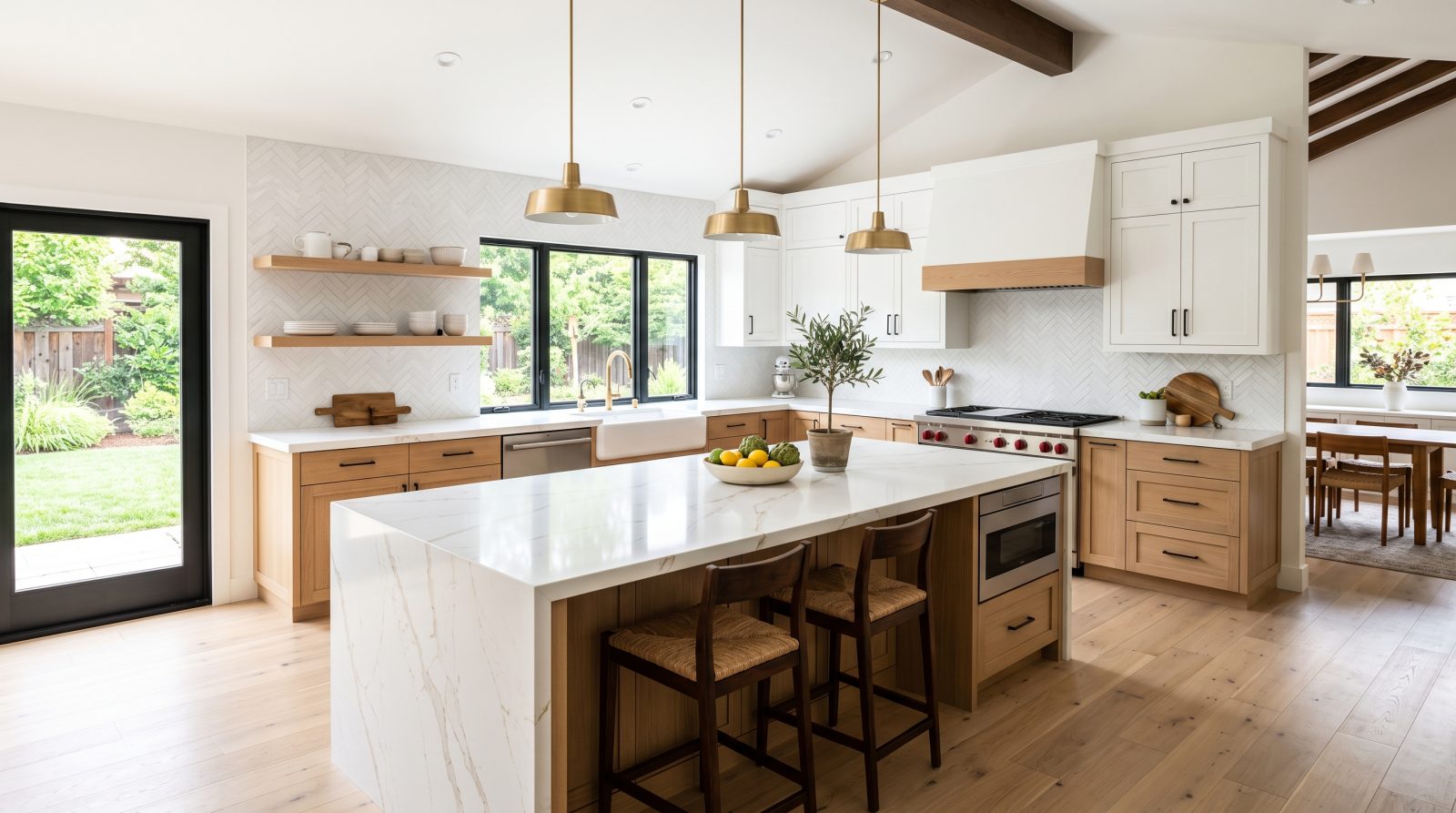
What does a kitchen remodel typically include?
Kitchen remodels vary widely in scope, and the word "remodel" can mean anything from swapping countertops to taking the room down to the studs. Figuring out which tier matches your goals helps you set a realistic budget and timeline before you ever talk to a contractor.
A cosmetic refresh keeps the existing layout and most of the existing infrastructure in place. A pull-and-replace remodel updates the major surfaces and fixtures but leaves plumbing, gas, and major electrical in roughly the same spots, which keeps permitting simpler. A full remodel relocates the sink, range, refrigerator, or walls, which brings in more trades, more inspections, and a longer schedule.
Most kitchen remodels touch several trades in sequence: demolition, framing or carpentry, plumbing, electrical, drywall, flooring, cabinetry, countertops, tile, and finish work. A general contractor typically coordinates these trades so the work happens in the right order and passes inspection.
- Cosmetic refresh: paint, cabinet refacing or new doors, hardware, countertops, backsplash, lighting, and appliance swaps within the existing layout
- Pull-and-replace: new cabinets, countertops, sink, faucet, flooring, and appliances in the same footprint
- Full remodel: relocating the sink, range, or appliances; moving or removing walls; reworking plumbing, gas, and electrical
- Common finishing details: backsplash tile, under-cabinet lighting, recessed lighting, and updated outlets to meet current electrical code
How much does a kitchen remodel cost in the Bay Area?
Kitchen remodel costs depend heavily on scope, the size of the kitchen, the quality of materials, and how much of the layout changes. The figures below are typical planning ranges for the San Francisco Bay Area; they are not quotes, and your actual price can land outside these ranges depending on your specific project.
As a general pattern, a cosmetic refresh tends to be the most affordable tier, a mid-range pull-and-replace remodel sits in the middle, and a high-end or layout-changing remodel costs the most because it adds trades, custom materials, and permitting. Bay Area labor and material costs tend to run higher than national averages, so it's worth budgeting a contingency for surprises uncovered during demolition, such as outdated wiring, water damage, or plumbing that no longer meets code.
Because these are estimates, treat them as a starting point for conversation. The most reliable way to know what your kitchen will cost is a detailed written estimate that itemizes labor, materials, permits, and any allowances for fixtures you'll choose later.
- Cosmetic refresh: typically the lowest-cost tier, often a fraction of a full remodel
- Mid-range pull-and-replace: typically the most common project, with cost driven by cabinet and countertop choices
- High-end or layout-changing remodel: typically the most expensive, due to custom cabinetry, premium surfaces, and added trades
- Budget drivers: cabinet construction (stock vs. semi-custom vs. custom), countertop material, appliance tier, and how much plumbing or electrical moves
- Smart planning: set aside a contingency for hidden conditions found during demolition, and ask that estimates label allowances clearly
How long does a kitchen remodel take?
Timeline depends on scope, the availability of materials, and how smoothly inspections go. A cosmetic refresh can often wrap up in a couple of weeks, while a pull-and-replace remodel commonly runs several weeks. A full remodel that moves walls or relocates plumbing and gas can take a few months from demolition to final sign-off.
A surprising share of the schedule is spent waiting rather than building. Custom or semi-custom cabinets often have lead times of several weeks, countertop fabrication usually requires a templating step after the cabinets are installed, and permitted work has to pause for inspections at key milestones. Choosing your materials early helps keep the timeline from stretching.
Your contractor should be able to give you a sequence and an estimated schedule in writing. Build in some flexibility, since hidden conditions, backordered materials, and inspection scheduling can all shift the finish date.
- Cosmetic refresh: often a couple of weeks
- Pull-and-replace remodel: commonly several weeks
- Full remodel with layout changes: typically a few months
- Common schedule factors: cabinet lead times, countertop templating and fabrication, and inspection scheduling for permitted work
Do you need a permit to remodel a kitchen in the Bay Area?
In most Bay Area cities and counties, cosmetic work like painting, swapping a faucet, or replacing cabinets in the same location often does not require a permit, while work that changes plumbing, gas, electrical, or structural elements generally does. This is general educational information, not legal advice, and permit rules vary by jurisdiction, so confirm the specific requirements with your local building department before work begins.
The Bay Area spans many separate jurisdictions, including the City and County of San Francisco and cities across Alameda, Contra Costa, San Mateo, Santa Clara, Marin, Sonoma, Solano, and Napa counties. Each has its own building department, fee schedule, and review process, and older homes or those in historic districts may face additional review. Permitted work is typically inspected at milestones such as rough plumbing, rough electrical, and final.
A licensed general contractor will usually pull the required permits and coordinate inspections as part of the job. It's reasonable to confirm in writing who is responsible for permits, and to make sure the contractor is licensed for the scope of work. You can verify a California contractor's state license status independently, and you should confirm that permits and inspections are part of the plan before signing.
- Often no permit: painting, hardware, like-for-like fixture swaps, and cabinet replacement in the same location (verify locally)
- Usually permitted: moving plumbing or gas, adding or relocating electrical circuits, removing or moving walls
- Each Bay Area jurisdiction sets its own rules; verify with your city or county building department
- Confirm in writing who pulls permits, and verify the contractor's license for the scope of work
How do you find a trusted kitchen remodeling contractor near you?
Finding the right contractor matters as much as the design itself. A good fit is someone licensed for the work, experienced with kitchens similar to yours, clear in their written estimate, and responsive in communication. Comparing a few estimates side by side helps you understand the typical scope and spot any bid that's unusually high or suspiciously low.
Look for written, itemized estimates rather than a single lump sum, ask how allowances for fixtures and finishes are handled, and confirm the plan for permits, inspections, and a realistic schedule. It's reasonable to ask about the proposed sequence of work, how change orders are handled, and how the contractor protects the rest of your home during construction.
Contractors Near Me helps homeowners across the San Francisco Bay Area connect with local contractors for projects like kitchen remodeling. There's no phone number to call; instead, you can request a free quote and we'll help match you with a contractor for your project. Always verify licensing, permits, and the details of any written agreement before work begins.
- Ask for a written, itemized estimate that separates labor, materials, permits, and allowances
- Compare a few estimates to understand typical scope and pricing
- Confirm the plan for permits, inspections, and a realistic schedule in writing
- Verify the contractor's license and insurance independently before signing
- Request a free quote through Contractors Near Me to get matched with a local contractor