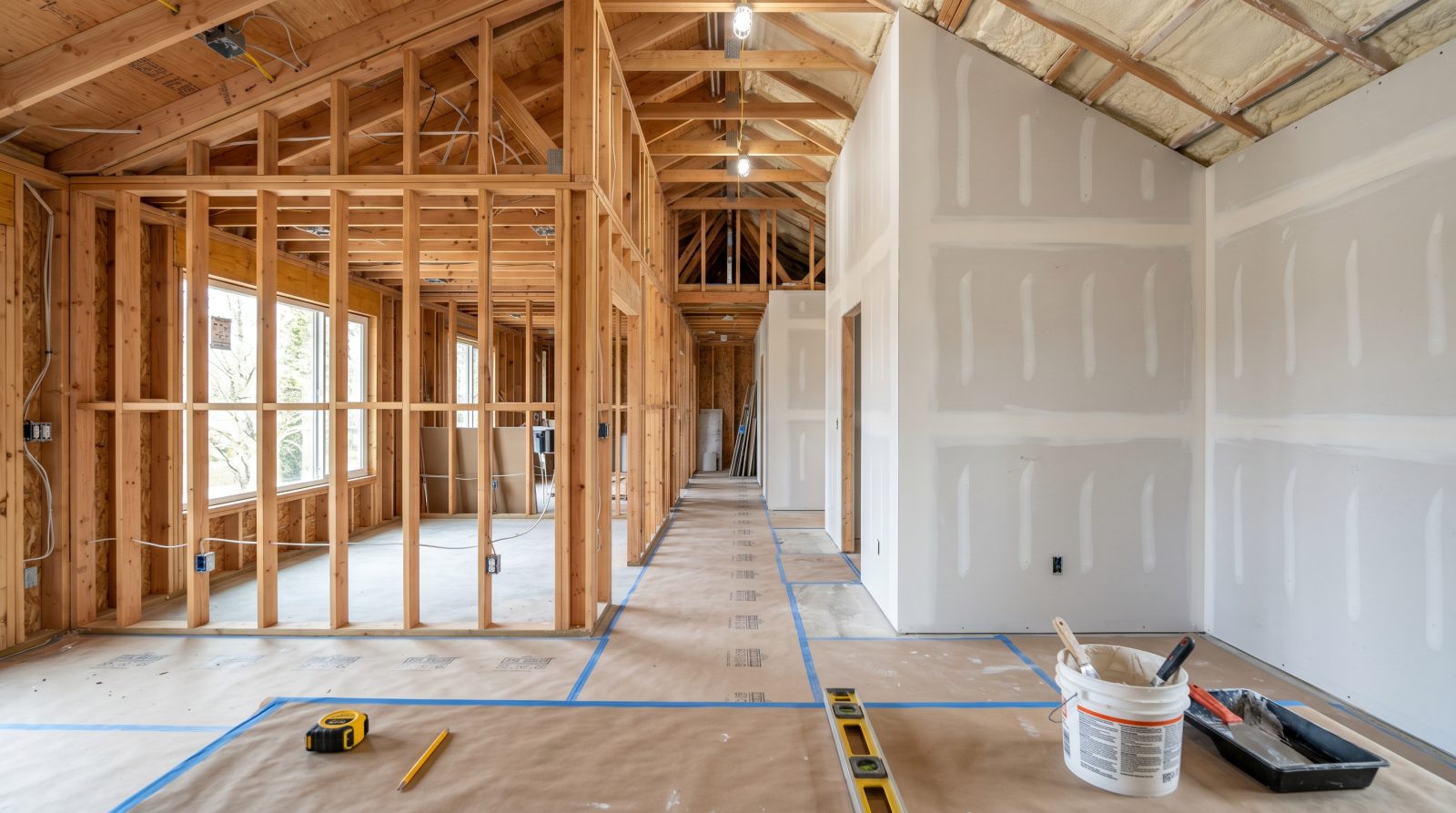
What do drywall and framing services include?
Framing and drywall are usually discussed together because one follows the other, but they are distinct phases of work. Framing creates the structure: vertical studs, horizontal plates, headers over openings, and blocking that gives walls, ceilings, and openings their shape and load path. Drywall is the surfacing stage: panels (commonly half-inch for walls and ceilings, with moisture-resistant or fire-rated types used where conditions call for them) are hung, fastened, taped at the seams, coated with joint compound in successive layers, sanded, and prepped for primer and paint.
Most contractors handling this work cover a predictable set of scopes, even when only part of the project is visible to you at the end. Knowing what is typically included helps you compare quotes and understand where the labor and time go.
- New interior wall framing for room divisions, closets, and additions
- Drywall hanging, taping, mudding, sanding, and finishing to a paint-ready surface
- Drywall patching and repair after water damage, leaks, or removed fixtures
- Ceiling drywall, including replacing or smoothing over older textured ceilings
- Framing for door and window openings, niches, and built-ins
- Cleanup and debris removal of old materials
How long does a drywall and framing job take?
Timelines vary widely with scope, so treat any single number as a starting point rather than a promise. As a general guide, a small drywall patch can be a part-day to one-day job, while framing and drywalling a full room is typically several days to a week or more once finishing is included. The reason finishing stretches the schedule is that joint compound is applied in coats, and each coat usually needs to dry before the next is added and sanded.
Several factors push a project toward the longer end of the range. Larger square footage, multiple rooms, high or vaulted ceilings, and complex framing with many openings all add labor. Projects that require permits and inspections also build in scheduling time, because inspections often happen between framing and closing up the walls. If your job involves structural changes, electrical or plumbing in the walls, or other trades, the framing and drywall steps have to be sequenced around that work.
- Small patch or single repair: often part of a day to one day
- One full room, framed and finished: commonly several days to about a week
- Multi-room or addition work: typically longer, sequenced with other trades
- Add time for permit reviews, inspections, and drying between compound coats
Do drywall and framing projects need a permit in the Bay Area?
Permit requirements depend on the scope and on your specific city or county building department, so the most reliable answer is to verify with your local jurisdiction before work starts. As a broad pattern across Bay Area cities, cosmetic drywall repair and patching often does not require a permit, while building new walls, structural framing, altering load-bearing elements, or work tied to an addition or conversion commonly does. Many jurisdictions also require permits when drywall work is connected to electrical, plumbing, or insulation changes inside the wall.
When a permit is involved, an inspector typically needs to see the framing (and any wiring or plumbing) before the drywall closes it up, which is why sequencing matters. A licensed local contractor can usually tell you whether your project is likely to need a permit and can pull permits on your behalf in many cases. This page is educational and not legal advice; confirm permit rules and contractor licensing directly with your city or county and verify any contractor's license status before hiring.
What does drywall and framing typically cost?
Costs are best understood as typical industry ranges, not quotes, because pricing depends on square footage, ceiling height, drywall type and thickness, the complexity of the framing, access, and how much finishing and texture matching is required. In higher-cost regions like the San Francisco Bay Area, labor rates tend to sit toward the upper end of national ranges. The figures below are estimates to help you plan and compare bids; an on-site assessment is the only way to get an accurate number for your project.
Smaller, well-defined work such as a single drywall patch is usually the most affordable line item, while framing plus drywalling and finishing an entire room is a larger investment that scales with size and detail. Removing and replacing damaged framing, addressing moisture-resistant or fire-rated materials, and matching existing wall texture can all add to the total. To turn these ranges into a real number, request a free quote and have a contractor evaluate the space in person.
- Drywall repair or patching: priced per patch or by the hour; smaller jobs are typically the lowest-cost work
- Drywall installation and finishing: commonly estimated per square foot of installed, finished surface
- Wall framing: often estimated by linear foot of wall or by the room, separate from the drywall surface
- Cost drivers: ceiling height, material type (standard vs. moisture-resistant or fire-rated), texture matching, and access
- All figures are typical estimate ranges, not fixed pricing; an in-person assessment sets the actual cost
How should I prepare for a drywall and framing project?
A little preparation makes the work faster and the quotes more accurate. Start by clearing the work area: move furniture, take down wall hangings, and give the contractor a clean path to the walls and ceilings being worked on. Drywall sanding produces fine dust, so it helps to plan for sealing off adjacent rooms and protecting floors and belongings.
Before requesting a quote, it's useful to know the scope you want, whether you are repairing, building new walls, or finishing an addition, and to flag anything behind the walls such as electrical, plumbing, or known moisture issues. Sharing photos and rough measurements speeds up estimates. When you are ready, request a free quote and a local Bay Area contractor can confirm the approach, whether a permit is likely needed, and how the work will be sequenced with any other trades.
- Clear and protect the work area, and plan for dust containment during sanding
- Define your scope: repair, new walls, ceiling work, or an addition
- Note anything inside the walls, including wiring, plumbing, and past water damage
- Gather photos and rough measurements to make quotes more accurate
- Confirm whether a permit and inspection are likely before work begins